Showing posts with label Friday Flag. Show all posts
15 January 2016
Friday Flag - CSA
The Confederate States of America was founded in 1861 when seven states broke from the United States. War never developed from the break but several more states joined the CSA after the United States outlawed slavery. While there was no open warfare the USA continually led raids to free slaves in border regions and skirmishes resulted.
As the end of the 19th century approached the CSA became an economic backwater. Larger US entities more likely to establish relations with Mexico than with the Confederates. By 1876 Texas was the first state to leave the CSA.
Texas didn't last long as an independent nation. Mexico, with the USA looking the other way, invaded and annexed the territory. The CSA fought a brief war with Mexico as a result but the United States acted as a mediator.
As the 20th century dawned the CSA got involved in a war with Spain which led to coastal settlements in Florida and South Carolina being bombarded and Spain retaining hold over its colonies. Within a decade Cuba and Puerto Rico would become the Caribbean Commonwealth, a semi-autonomous part of the Spanish Empire.
During the Great War the German Empire sent the Zimmerman Telegraph to the Confederate States trying to bring them into the conflict. In no condition to invade the United States the CSA remained neutral.
Florida eventually left the CSA and joined the Caribbean Commonwealth. Virginia, for years economically outpaced by West Virginia, leaves the CSA and asks for re-admittance to the United States in 1927, bringing the CSA back down to 7 states.
While slavery was on a decline over the decades it wasn't until a Constitutional amendment in 1936 did the CSA officially end slavery. They would remain a economic disaster area for decades with the more powerful USA and Mexico dominating and exploiting their economy.
01 January 2016
Friday Flag - Seljuk Empire
Happy New Year to everyone! It's Friday, time for a new alternate history flag.
Today I present the flag of the Seljuk Empire. In our timeline the Sultanate of Rum collapsed in the early 14th century eventually leading to the Ottoman Empire being formed.
In this alternate the Seljuq Dynasty (founded in the 10th century) continued to dominate Anatolia. The ongoing conflicts with the Roman Empire (historiographically known as the Byzantine Empire) helped the Seljuk maintain control over the other Turkish lines. They would led the eventual conquest of Constantinople in 1444 allowing them to solidify their own reorganized empire.
As this history continues it the Seljuk Empire would likely develop along similar lines as the OTL Ottoman Empire did. Its survival would depend on the numerous small changes over the centuries leading up to the Great War.
The central symbol on this flag was taken from a file uploaded by Mevlüt Kılıç to Wikipedia. Therefore this image is also covered by the Creative Commons ShareAlike attribution.

Seljuk Empire flag by Sean Sherman, based on work of Mevlüt Kılıç is licensed under a Creative Commons Attribution-ShareAlike 4.0 International License.
Labels:
Delta-001,
Divergence 1307,
Friday Flag,
Seljuk,
Turkey
11 December 2015
Friday Flag - The United Kingdoms of England and France
In 1120 William Adelin survived the wreck of the White Ship. He went on to become King of England continuing the line of the House of Normandy. There would be no succession crisis as William III took the throne in 1135 at the age of 32. England remained stable and William III produced an heir.
War with France in the early 13th century allowed for expansion of England's territory. The Anglo-French War of 1201 to 1212 was waged by King Robert III, and was a decisive English victory. Phillip II of France was killed in 1212 and his son Louis VIII became King of what remained of France.
The Albigensian Crusade allowed the English to complete their domination of France as they crushed the Cathar in the name of the Catholic Church. In 1228 Louis VIII lost his throne as France became part of the Kingdom of England.
In 1235 the flag of of the United Kingdoms of England and France was issued. The United Kingdoms would continue to dominate European and then world politics for centuries.
20 November 2015
Friday Flag - Canadian Bermuda
Canada continues to grow with the addition of Bermuda on 1 July 2014. It is currently a territory but is expected to become a province before October 2019. Bermuda is a strategic location for Canada as a good mid-point between the mainland and her Caribbean and Central American territories.
The transition to its new status has gone well for Bermuda. Queen Elizabeth II has approved of the merger. Charles, Prince of Wales was in Bermuda on 1 July for the ceremony.
Major changes in Federal politics are not expected. With only 63,000 people even combined with the existing West Indies and Belizean citizens, there should be no major change in the House of Commons or Parliament.
06 November 2015
Friday Flag - USSA
Still plugging away at my NaNoWriMo project for this year. Still it's time for a new flag. Here is a flag for a communist United States. I have no real background for it, mainly because I can't come up with one that is even a tiny bit plausible. So no extra writing is required and I can get back to my novel.
The red blocks each represent one of the 48 states. I was inspired in the creation of this flag on something I saw online somewhere, I think it was the People's Cube. Enjoy.
09 October 2015
Friday Flag - Second Peru-Bolivian Confederation
After years of civil war and then a war with the United States the nation of Chile was in a weakened state. On 3 June 1884 Peru and Bolivia both declared war on Chile to reclaim lost territory. Despite Chile's weakness Peru and Bolivia were only in slightly better shape, having not fully recovered from the War of the Pacific. It took nearly two years for territories lost in the War of the Pacific to be recovered.
When the so-called Second War of the Pacific ended in 1886 Peru and Bolivia moved to enhance their security and further cooperation by forming the Second Peru-Bolivan Confederation. Andrés Avelino Cáceres became the first president of this new state thanks to his victories as General of Peru's armies during the Second War of the Pacific. He had to deal with the huge debts created by the two wars and integrating increasingly disruptive rebel groups into the new nation.
An agreement was made to eliminate the debt by giving control of its railroads and other concessions. It was a very unpopular move, but the nitrate deposits in the recently recovered territories would help the economy once they were running at full capacity again by 1888.
Peru-Bolivia would continue to suffer insurgencies, rebellions, and a shaky economy for years to come. The future threat of a revitalized Chile one day invading was another threat.
25 September 2015
Friday Flag - Kurland
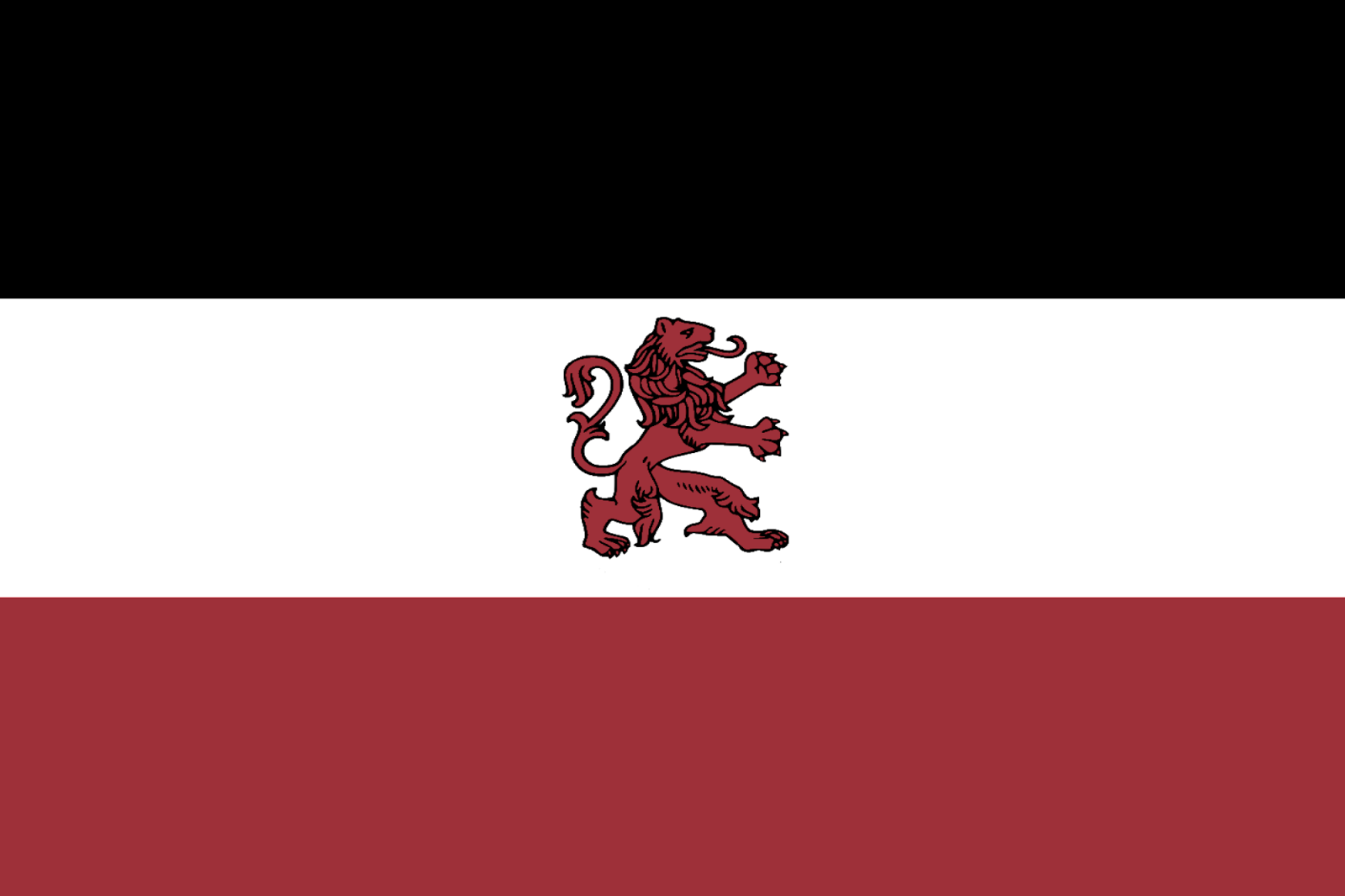
With the victory of the Central Powers in the Great War the German Empire established the new country of Kurland. This German puppet included the cities of Riga in the north to Brest-Litovsk in the south. The islands of Ösel and Dagö.
Inspiration for this flag came from the Atlas of World War I by Martin Gilbert (ISBN 0-19-521077-8). On page 46 was a map of 'German War Aims In Eastern Europe 1914-1918' which showed Kurland, a tiny landlocked Poland, and Ukrainian People's Republic.
The lion rampant is from the coat of arms of Courland. The colors are from the German and Latvian flags.
11 September 2015
Friday Flag - Duchy of Djibouti
In 1937 the Duchy of Djibouti was on of two colonies of the Królestwo Zachodnim Afganistanie that gained independence. The KZA's naval power was almost non-existent and the regular military conflicts with China and rebel hunting in the Russian Empire took nearly all of the nation's focus. It was felt that releasing the colonies from the Kingdom would allow them to better develop on their own.
The odd mix of politics and religion from the Królestwo Zachodnim Afganistanie carried over to the Duchy of Djibouti. Duke Cumar Grabowski took over as head from his father, Duke Stanislaw Grabowski. Prime Minister Xasan Aref Geelle controlled many day-to-day operations as the new country made a step towards becoming a constitutional monarchy. During the original colony's founding a large portion of southern Ethiopia was conquered and added to the Duchy.
A war between Djibouti and Ethiopia form 1940 to 1942 helped solidify the new nation and in the end brought Djibouti and Ethiopia on a road to lasting peace. As part of the terms of the Djibouti victory in the conflict, Prince Ismaaciil Grabowski would marry Princess Tsehai Haile Selasasie of Ethiopia. She was the youngest daughter of the Ethiopian emperor.
28 August 2015
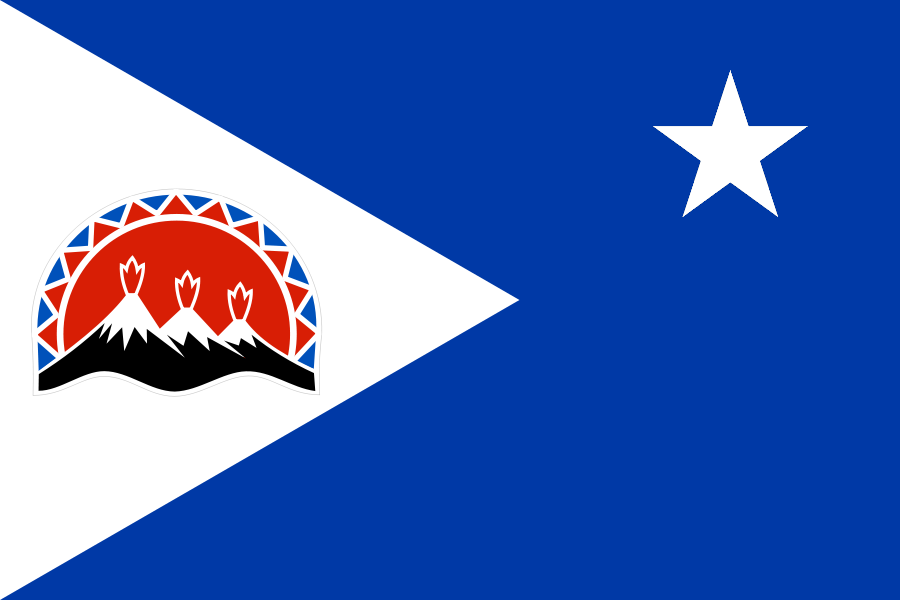
Friday Flag - Kamchatka-Chukotka Territory
As the Russian Civil War raged across east Europe and north Asia the United States of America sent an expeditionary force to help the White Russians. This force was sent to the Russian Far East and additional troops were sent in a show of strength against the Japanese. However, after regular interactions with Admiral Kolchak it became apparent that the Whites were doomed and the Bolsheviks would win the long, bloody struggle.
After spending lives and resources in a futile conflict it was decided to make the best of things by occupying the population centers of Kamchatka and Chukotka. In 1921 America offered Lenin relief supplies and money in return for the territories. Lenin, seeing the offered items as more useful in the struggle in Europe than in the far off tundra, agreed and sold the land. The Kamchatka-Chukotka Territory was born.
The discovery of gold and other unexploited resources brought immigrants from the US and other areas. Development began to take place. However the Second World War would derail this development.
In spring 1942 Japanese forced landed in Kamchatka-Chukotka and drove the remaining, limited, American forces into the wilderness. The difficulties of reconquest and the larger concerns in the Pacific lead to the territory being effectively abandoned. The United States spent more of its efforts in the Pacific than in Europe in the war as a result. A land invasion of Japan took place in 1944 and the Japanese surrendered in 1946.
The Soviet Union, under Trotsky, invaded and re-annexed Kamchatka and Chukotka in 1945. The United States was powerless to stop them. Soviet forces also occupied all of Germany as well as norther Italy as the European war ended in 1945.
Several thousand American soldiers who survived the Japaneses invasion were captured by the Soviets and few were ever returned home.
30 January 2015
Friday Flag - Triple Monarchy
With Italy joining the Central Powers during the Great War the Allies sued for peace and Germany found itself dominating the continent. Serbia was officially annexed into the Austro-Hungarian Empire in 1920.
Emperor Charles I & IV was looking for ways to keep his empire together. By 1932 the Dual Monarchy became the Triple Monarchy as Slavs were given more power as the Hungarians were. This was done both to placate the Slavic peoples of the empire and to take some power away from the Hungarians.
The updated flag added the colors of Serbia. Austria was moved to the center and only its crow appeared on the flag.
The flag stayed in use until 1964 when the empire collapsed and was broken into separate Austrian, Hungarian, and Yugoslav states.
16 January 2015
Friday Flag - Liberia
Liberia was established in 1822 by the American Colonization Society. It gained independence in 1847. Liberia was home to a number for freed slaves from America.
The Republic of Maryland was established near Liberia by the Maryland State Colonization Society. Draconian laws to limit the liberty of freed slaves in Maryland. These laws were used to coerce free blacks into moving to the colony or face the possibility re-enslavement. In 1854 the Republic of Maryland declared its independence and decided not to join Liberia. The Maryland State Colonization Society wanted to try to maintain its monopoly on trade.
In 1855 both Maryland and Liberia were attacked by an alliance of various local tribes. Both small nations coordinated their defenses and eventually merged into one state in 1859. At the end of the war eleven counties formed the new, larger Liberia. The colors of the Republic of Maryland's flag were chosen for the new flag of the nation. One of the reasons of the change in flag was to stop using the colors of the United States in an attempt for form their own identity. Eleven stripes on the flag represent the signatories of the Liberian Declaration of Independence. The American tradition of adding stars to a blue field as new territories were admitted was adopted.
In 1944 the collapse of the British government during the Second World War gave Liberia a chance to add three more stars (to 18) to its canton with the admission of Sierra Leone into the nation. While many of Britain's former colonies were turned into United Nations mandates after the Axis was finally defeated in 1947, the union of Sierra Leone to Liberia was allowed to stand.
02 January 2015
Friday Flag - Free City of Tri-Insula
The Free City of Tri-Insula was the name taken by New York City when it seceded from New York State during the the outbreak of the Civil War. Mayor Fernando Wood did not want to stay with the state after it seceded with many other northern states after Douglas won the Presidential Election of 1860. Wood wanted to continue trading with both sides and the outside world. He did not want the people of his city to be drafted into the armies of the Federation of Free America in its rebellion against the USA.
The Free City of Tri-Insula lasted from September 8, 1861 to November 17, 1861, just over two months. In November armies from New York and various New England states took back the city, bringing it back into the FFA.
19 December 2014
Friday Flag - New Belize (2002-2013)
Finally getting back in the swing of things. Starting off a bit on the silly side with this week's flag; an alternate Belize where things didn't work out so well:
In 1987 the Coca-Cola corporation formed a subsidiary called Coke Belize Enterprises, Ltd. This new entity was responsible for developing the supplies of raw materials for Coke products. It started with a 500,000 acres of land for citrus development. Over the years activities would expand in the small Central American nation.
1990: Coke Belize Enterprises expands operations into sugar production. Large amounts of land are purchased from the state and local farmers. Wages in the country are steadily increasing with the increasing number of jobs on the farms and in construction.
1994: NAFTA gives an incentive to further developments in Belize.
1999: To combat negative press about operation in Belize there are further investments and increased wages of workers. High inflation is now gripping the nation. Corporate influence in national politics gives Coke Belize Enterprises de facto control over the government.
2000: The Caribbean Highway is completed. It allows for easy transport of product to port. Late in the year an agreement is reached with Guatemala to allow them low tariffs to use the highway.
2002: A new national flag is introduced (see image above). It is nearly universally despised. Hyper-inflation, corporate control of their country, and massive immigration is causing long term residents to become increasingly angry.
2004: Rebels begin missions to disrupt and destroy Coke Belize Enterprises operations. The military seems unwilling to combat the rebels. Foreign mercenaries are brought in towards the end of the year to spearhead the counter-insurgency.
2008: Violence begins to increase in Belize as the economy begins to suffer more. It becomes clear to some that central planning for a nation by a corporation is little better than central planning by a communist dictator. Coke Belize Enterprises is attempting to find a way to cut their increasing losses and end the violence. They turn to the United States for help.
2010: After the mid-term elections in the US the President tries to boost his sagging poll numbers by working on a plan to eventually bring Belize into the United States as a new state. When details of this plan are leaked there is general outrage, particularly from the UK. There is also a spike of violence in Belize.
2013: US Troops and counter-terrorism assets arrive in Belize for peacekeeping operations. Operation: No Deposit, No Return begins; it includes drone strikes on insurgency bases in Guatemala. Towards the end of the year a vote his held to determine the fate of the country. With a large number of citizens unable to vote due to 'terrorist ties' and other irregularities, Belize 'chooses' to become a territory of the USA. The territorial flag is changed back to the original flag of Belize.
In 1987 the Coca-Cola corporation formed a subsidiary called Coke Belize Enterprises, Ltd. This new entity was responsible for developing the supplies of raw materials for Coke products. It started with a 500,000 acres of land for citrus development. Over the years activities would expand in the small Central American nation.
1990: Coke Belize Enterprises expands operations into sugar production. Large amounts of land are purchased from the state and local farmers. Wages in the country are steadily increasing with the increasing number of jobs on the farms and in construction.
1994: NAFTA gives an incentive to further developments in Belize.
1999: To combat negative press about operation in Belize there are further investments and increased wages of workers. High inflation is now gripping the nation. Corporate influence in national politics gives Coke Belize Enterprises de facto control over the government.
2000: The Caribbean Highway is completed. It allows for easy transport of product to port. Late in the year an agreement is reached with Guatemala to allow them low tariffs to use the highway.
2002: A new national flag is introduced (see image above). It is nearly universally despised. Hyper-inflation, corporate control of their country, and massive immigration is causing long term residents to become increasingly angry.
2004: Rebels begin missions to disrupt and destroy Coke Belize Enterprises operations. The military seems unwilling to combat the rebels. Foreign mercenaries are brought in towards the end of the year to spearhead the counter-insurgency.
2008: Violence begins to increase in Belize as the economy begins to suffer more. It becomes clear to some that central planning for a nation by a corporation is little better than central planning by a communist dictator. Coke Belize Enterprises is attempting to find a way to cut their increasing losses and end the violence. They turn to the United States for help.
2010: After the mid-term elections in the US the President tries to boost his sagging poll numbers by working on a plan to eventually bring Belize into the United States as a new state. When details of this plan are leaked there is general outrage, particularly from the UK. There is also a spike of violence in Belize.
2013: US Troops and counter-terrorism assets arrive in Belize for peacekeeping operations. Operation: No Deposit, No Return begins; it includes drone strikes on insurgency bases in Guatemala. Towards the end of the year a vote his held to determine the fate of the country. With a large number of citizens unable to vote due to 'terrorist ties' and other irregularities, Belize 'chooses' to become a territory of the USA. The territorial flag is changed back to the original flag of Belize.
17 October 2014
Friday Flag - Confederation of Europe 1972
With the victory of the Central Powers in the Great War (Germany, Austria-Hungary, Ottoman Empire, Italy, Bulgaria) Germany dominated European politics. Over the next half-century Europe, and the world, went through a series of great changes. By 1972 Germany was able to forge a new Confederation of European States to maintain peace and stability in Europe.
The initial members of the Confederation were: Germany, France, Austria, Belgium, Denmark, Italy, Netherlands, Latvia, Lithuania, and Luxembourg. Each member state was represented by a star on the new flag. The Confederation would continue to gain members, welcoming its 24th member in 1999.
05 September 2014
Friday Flag - United State of the Ionian Islands
During the Congress of Vienna the United Kingdom wanted to gain rights to 'protect' the United State of the Ionian Islands. This group of seven islands off the coast of Greece had a number of ports that could be of use by the British. The Austrian Empire was not thrilled at the prospect of continued British expansion into the Mediterranean so they unexpectedly pushed for more rights there themselves.
With the numerous more important issues to be handled at the Congress, it was quickly decided that the British and Austrians would form a condominium over the islands. It quickly became apparent that the two powers would be unable to cooperate. This allowed the Ionians to exert much more control over their own territory. In late 1815 Ioannis Kapodistrias became President of the United State of the Ionian Islands. He became adept at playing the two powers against each other and advancing his own ends as they squabbled or ignored the islands.
While many inhabitants preferred British laws to Habsburg they desired their own freedom as well. Taking the best each culture had to offer and taking inspirations from ancient Greek city-states and modern American political innovations the tiny new nation tried to create its own identity.
In 1864 the British pushed to have the Ionian Islands annexed into the Kingdom of Greece. Luckily a half-century of relative independence allowed them to resist annexation. With Habsburg involvement now almost non-existent the Ionians turned to Imperial Russia for help. Turning to the Tsar to ensure their freedom was bizarre, but worked. By allowing Russian access to some of their ports they were able to get the Tsar to support their independence.
Again the United Kingdom had other more important interests to deal with and eventually let the matter drop.
22 August 2014
Friday Flag - Hussite Army 1437
On 6 July 1415 Jan Hus was murdered at the Council of Constance, King Sigismund of Luxembourg the ruler of Kingdom of Hungary having betrayed him with promises of protection. Hus was a religious man but saw faults with the Catholic Church. He attempted reforms from within only to be excommunicated. After his martyrdom the rising nationalism in Bohemia combined with religious unrest led to rebellion.
The Hussites were a very effective fighting force. Many new tactics were developed including war wagons. These helped play an important part in winning an independent Czech kingdom after numerous crusades against them. Finally a decisive victory at the Battle of Lipany in 1434 allowed them to finally get peace with King Sigismund in 1436.
The five failed crusades against the Hussites helped to spread their message of reform across Europe. The Church ended overt attempts to destroy them and changed their strategy to isolate the new Czech Kingdom and minimize the spread of what they considered the Hussite Heresy.
The flag above became the official flag of the Hussite armies after the end of the wars. It combined elements from a number of popular flags during the wars.
08 August 2014
Friday Flag - Amikejo
In 1816 a quirk in decisions during the Congress of Vienna created Neutral Moresnet. This area was about 1 square mile and contained a zinc mine neither the Netherlands nor Prussia wanted the other to control. For nearly a century the small territory survived the turmoil around it never being attacked or invaded. Even after the zinc mine went dry the town continued to boom as new enterprises grew.
Refugees, exiles, and adventurers from across Europe, and from as far as the United States and China, arrived in the territory boosting the population. This growth and new ideas helped to expand the economy of Neutral Moresnet. A lack of central authority and the option to use several different law systems to settle disputes also added to the uniqueness of the land.
In 1908 the territory had become a gathering point of speakers of Esperanto. Soon the territory declared its independence as Amikejo, a word in Esperanto meaning 'place of friendship'. The World Congress of Esperanto that met in Dresden declared the settlement the world capital of Esperanto.
Its neighbors were unsure what to do with this territory since both Belgium and Germany neglected for decades their obligation to oversee it. Neither wanted to cause a diplomatic situation on the others border. By 1920 with the German Empire more concerned with monitoring wars in the Balkans and failing Ottoman Empire paid less attention to its borders with Belgium and France. This allowed Amikejo to continue to prosper as a free trade city and through smuggling.
Amikejo would eventually gain recognition by other nations. Once this happened it became a small free state not much larger than Monaco.
(For more information on Neutral Moresnet see Peter C. Earle's short book A Century of Anarchy: Neutral Moresnet through the Revisionist Lens.)
25 July 2014
Friday Flag - Confederation of the Rio Grande and Texas
During the Battle of San Jacinto on 21 April 1836 Antonio López de Santa Anna was killed during the fighting. The war for Texan independence continued but the Mexicans suffered major setbacks after that battle. In 1837 another collection of Mexican states declared independence as the Republic of the Rio Grande. The battered Mexican Army gained made renewed attacks into the rebellious territory, but intervention by Sam Houston and his Texan forces secured the independence of the sister republic.
Having fought together against a common foe and facing an uncertain future together the two new republics formed the Confederation of the Rio Grande and Texas as a means to mutual defense and cooperation.
The flag of the Confederation has four stars - one for each of the states: Texas, Coahuila, Nuevo León, and Tamaulipas.
Labels:
Beta-017,
Friday Flag,
Mexico,
Texas
18 July 2014
Friday Flag - People's Republic of Sweden
Sweden suffered greatly during the Great War. A British blockade and Russian invasion devastated the country to such a point that the government collapsed towards the end of the conflict in April 1896.
By the end of 1896 Sweden was proclaimed a People's Republic. The German Empire did not like having a communist country so close to it so they supported an Danish conquest of Ostlandet in a war from 30 January 1899 to 31 May 1899. During those few months Germany and Norway helped Denmark annex a portion of Swedish territory.
Germany and Norway again invaded the People's Republic of Sweden on 1 June 1904 to add a stretch of Swedish territory to Norway. Having never recovered fully from the Great War much less the Danish Conquest of Ostlandet, the Swedes were forced to surrender on 3 July 1905 with the loss of additional territory. The territory gained by Norway included Nord-Noreg and Trøndelag.
11 July 2014
Friday Flag - Republic of Bangladesh
I sifted through my old notes for tabletop role-playing games I have run in the past looking for any flags I may have designed. I found an old version of this one, the Republic of Bangladesh. The world it come from is totally ASB. It was a game where the players were super-powered villains with various nefarious plans. In the mid-1990s China and the US went to war leaving them both, and western Europe, nearly totally destroyed. The Russian Federation became the anchor for civilization for a number of years.
During this time Bangladesh had more than its fair share of super-inventors. They could take scrap out of a junkyard and turn it into wondrous technological devices. It did not take long for them to dominate southern Asia and eventually northern Africa.
Subscribe to:
Posts (Atom)